Peter Lobner, updated 16 February 2026
1. Introduction
The Main Directorate of Deep-Sea Research, also known as GUGI and Military Unit 40056, is an organizational structure within the Russian Ministry of Defense that is separate from the Russian Navy.

http://eng.mil.ru/en/index.htm
Vice-Admiral Aleksei Vitalyevich Burilichev, Hero of Russia, served as the Head of GUGI for fifteen years from 2005 until his death due to complications from coronavirus on 25 November 2020. His successor is Vice-Admiral Vladimir Vladimirovich Grishechkin, who assumed command of GUGI on 15 March 2021.

vessel Yantar. (R) Vice-Admiral Vladimir Vladimirovich Grishechkin
Sources: (L & R) http://eng.mil.ru/
GUGI is responsible for fielding specialized submarines and “oceanographic research” ships, as well as a variety of undersea drones, autonomous vehicles, sensor systems, and other undersea systems. GUGI also is responsible for the development of the Poseidon (formerly known as Status-6 / Kanyon) strategic nuclear torpedo and the associated “carrier” submarines.
The GUGI fleet provides Russia with deep ocean and Arctic operating capabilities that greatly exceed those of any other nation. Potential missions include:
- Conducting subsea surveys, mapping and sampling (i.e., to help validate Russia’s extended continental shelf claims in the Arctic; to map potential future targets such as seafloor cables and pipelines)
- Placing and/or retrieving items on the sea floor (i.e., retrieving military hardware, placing subsea power sources, power distribution systems and sensor arrays)
- Maintaining military subsea equipment and systems
- Conducting covert surveillance
- Developing an operational capability to deploy the Poseidon strategic nuclear torpedo.
- In time of war, attacking the subsea infrastructure of other nations in the open ocean or in the Arctic (i.e., cutting subsea internet cables, power cables or oil / gas pipelines)
Today, GUGI operates the world’s largest fleet of covert manned deep-sea vessels and an impressive surface fleet.
You can download a pdf version of this article here.
2. Homeport for GUGI fleet is in Olenya Bay
GUGI submarines, surface vessels and their support facilities are homeported at Olenya Bay, near Murmansk, on the Kola Peninsula, with direct access to the Barents Sea. The nuclear submarines are operated by the 29th Special Submarine Squadron.

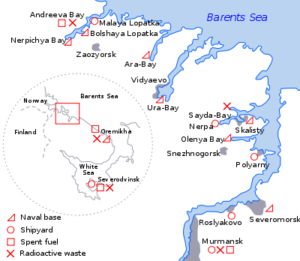

Source: Barents Observer (15 June 2023), adapted from 3D Google Earth image

Source: RussianMilitaryAnalysis (3 Jul 2019)
3. GUGI’s manned submarine fleet
On behalf of GUGI, Russia’s 29th Special Submarine Squadron operates the world’s largest fleet of covert, manned, nuclear-powered submarines, including six smaller deep-sea submarines and three larger “motherships.” GUGI operates a variety of unmanned underwater vehicles (UUVs) that can be deployed from its manned submarines and/or surface vessels. GUGI also operates several small, electrically-powered, deep-diving manned submersibles that can be deployed from its surface vessels.
3.1 Nuclear-powered, manned, deep-diving submarines
Seven nuclear-powered, deep-diving, small submarines (“nuclear deep-sea stations”) have been associated with GUGI. Each is capable of working at great depth (thousands of meters) for long periods of time. These subs are believed to have diver lockout facilities to deploy divers at shallower depths.
The trend clearly is toward larger, and certainly more capable deep diving special operations submarines. After NR-1 was retired in 2008, the U.S. Navy with no crewed counterpart to this Russian fleet of small, nuclear-powered, deep-diving, special operations subs.
- Project 1851 / 18510M Nelma (aka Almaz & X-Ray) sub designated AS-23: This small sub was delivered in 1986. Its length is 44 m (144.4 ft.), displacement is about 529 tons submerged and it is designed for operation at depths up to about 1,000 m (3,281 ft). This is the first and smallest of the Russian special operations nuclear-powered submarines. The AS-23 is roughly comparable in size to the U.S. Navy’s former NR-1 (now decommissioned), which had a length of 45 meters (147.7 ft.) and a displacement of about 400 tons submerged.

- Project 18511 Halibut (aka Paltus) subs designated AS-21 and AS-35: These two small subs were delivered between 1991 and 1995. Their length is 55 m (180.4 ft), displacement is about 730 tons submerged and they are designed for operation at depths up to about 1,000 meters (3,281 feet).

- Project 1910 Kashalot (aka Uniform) subs designated AS-13, AS-15 and AS-33: These three small subs were delivered between 1986 and 1994. Their length is 69 m (226.4 ft.) and displacement is about 1,580 tons submerged. There were reports prior to 2018 that AS-33 is no longer in service, and may have been written-off.

floating dry dock. RussianMilitaryAnalysis (3 Jul 2019)

Source: adapted from militaryrussia.ru

landing legs and tools for working on the bottom.
Source: http://nvs.rpf.ru/nvs/forum
- Project 09851 titanium-hulled sub designated AS-31 Losharik (aka NORSUB-5): This sub was delivered in about 2003. It has a length of 74 m (242.8 ft.), a displacement of about 2,100 tons submerged, and is capable of operating to a depth of 6,000 m (about 20,000 ft). The AS-31 was severely damaged in 2019 by a fire that killed 14 crew members. It is expected to be ready for sea trials in 2025 after nearly five years in the shipyard for repairs, refueling and modernization. The titanium hull apparently was not damaged by the fire. For more information on Losharik, see H.I. Sutton’s updated 2021 article, “ Spy Submarine: Russia’s AS-31 Losharik


3.2 Nuclear-powered “motherships”
GUGI operates several large nuclear-powered “motherships” (“PLA carriers”), each of which can transport one of the smaller nuclear-powered deep-sea stations and/or a variety of uncrewed underwater vehicles (UUVs) to a distant site and provide support throughout the mission. Each mothership is a converted Russian Navy strategic missile submarine (SSBN) or cruise missile submarine (SSGN).
- Project 09786 mothership designated BS-136 Orenburg: This modified former Delta III SSBN was converted and delivered to the Russian Navy in 2002. It is now non-operational, and is expected to be written off.
- Project 09787 mothership designated BS-64 Podmoskovye: This modified former Delta IV SSBN was converted and delivered to the Russian Navy in December 2016.
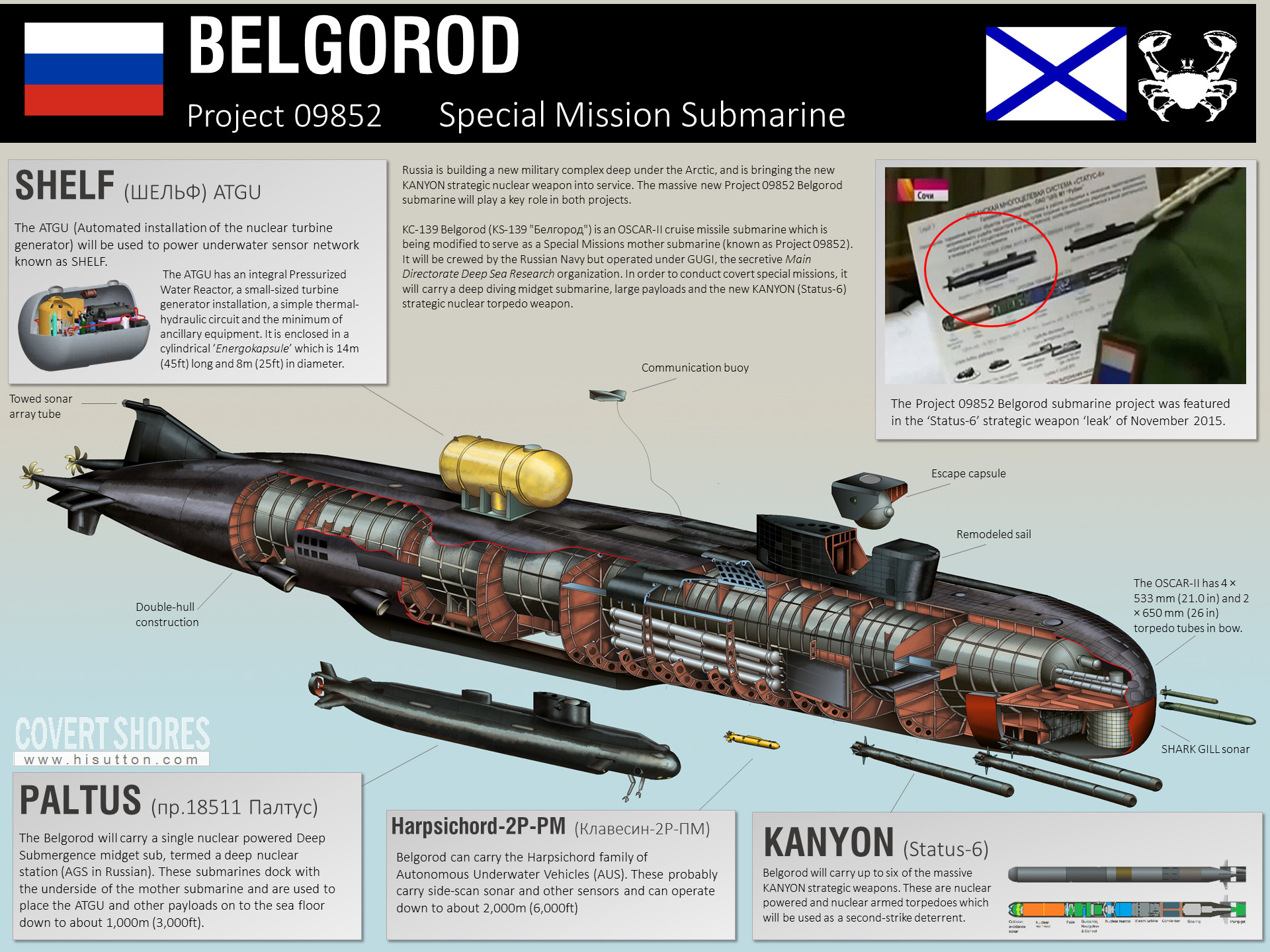
- Project 09852 mothership designated KC-329 Belgorod. This modified former Oscar II SSGN was converted and delivered to the Russian Navy in July 2022. This 30,000 ton multipurpose platform also is designed to carry six 2M39 Poseidon nuclear-powered, nuclear-armed strategic torpedoes.
The BS-136 and BS-64 motherships started life as Delta III and Delta IV strategic ballistic missile submarines (SSBNs), respectively. The original SSBN missile tubes were removed and the hulls were lengthened to create a large midship special mission section with a docking facility on the bottom of the hull for one of the small deep-diving submarines. These motherships probably have a test depth of about 250 to 300 meters (820 to 984 feet). They are believed to have diver lockout facilities for deploying divers.


Source: http://www.air-defense.net/


carrying Losharik. Source: GlobalSecurity.org
The larger KC-329 mothership started life as an Oscar II cruise missile submarine. As with the BS-136 and BS-64 motherships, KC-329 received a large (30 m / 98.4 ft) midship special mission section with a docking facility on the bottom of the hull for one of the small deep-diving submarines. The former flank-mounted cruise missile launchers were removed.

Source: militaryrussia.ru


4. Unmanned underwater vehicles (UUVs)
The GUGI surface ships and submarine motherships are believed capable of deploying and retrieving a variety of unmanned underwater vehicles (UUVs), including the relatively large Harpsichord (aka Klavesin) autonomous underwater vehicle (AUV) developed by the Rubin Design Bureau (aka Central Design Bureau for Marine Engineering “Rubin”). Harpsichord is a multi-mission platform capable of operating to a depth of about 2,000 m (6,562 ft). It has a length of 6.5 m (21.3 ft.), diameter of 1 m (3.2 ft.) and weight of 3,700 kg (8,157 pounds).


5. Poseidon (aka Kanyon) strategic nuclear torpedo & submarine “carrier vehicles”
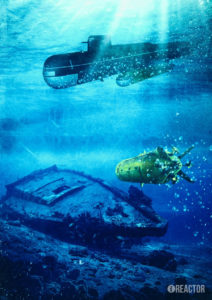
Poseidon, which was first revealed on Russian TV in November 2015, is a large, nuclear-powered, autonomous underwater vehicle (AUV) that functionally is a giant, long-range, nuclear-armed torpedo. It is reported to be capable of delivering a very large nuclear warhead (perhaps up to 100 MT) underwater to the immediate proximity of an enemy’s key economic and military facilities in coastal areas. It is a weapon of unprecedented destructive power and it is not subject to any existing nuclear arms limitation treaties.

The immense physical size of the Poseidon strategic nuclear torpedo is evident in the following size comparison chart. In this chart, the Bulava is the Russian submarine launched ballistic missile (SLBM) carried on modern Borei-class SSBNs. The UGST torpedo is representative of a typical torpedo launched from a 533 mm (21 inch) torpedo tube, which is found on the majority of submarines in the world.

In January 2026, the U.S. Naval Institute reported that the Russian Navy had announced plans to procure at least 30 Poseidon strategic torpedos to deploy on four submarines—two in the Northern Fleet and two in the Pacific Fleet.
Currently, three types of Russian submarines are capable of carrying the Poseidon strategic torpedo:
- Project 20120 B-90 Sarov experimental nuclear-electric submarine: This sub was delivered to the Russian Navy in 2008. It appears to have been modified with a single, large, horizontal launcher in the bow, outside the submarine pressure hull, enabling it to serve as a carrier vehicle for the Poseidon strategic torpedo. For more information on Sarov, see H.I. Sutton’s updated 2019 article, “ SAROV-Class Submarine.”

- Project 09851 nuclear-powered Khabarovsk: TThis is the lead boat of what originally was planned to be a four-boat class of submarines. This nuclear-powered sub was designed originally as a strategic nuclear torpedo carrier armed with six 2M39 Poseidon strategic torpedoes in launch tubes located in the bow. The sub’s keel was laid in 2014 at the Sevmash Shipyard in Severodvinsk, on the White Sea. A ceremonial launch took place when the sub was rolled out of its construction hall on 1 November 2025 and the sub finally entered the water around 30 November 2025. For more information on Khabarovsk, see H.I. Sutton’s updated 2019 article, “New in Russia: Khabarovsk Class Submarine.”

Source: H.I. Sutton via Naval Institute Proceedings Jan 2026

Source: The War Zone, 3 Nov 2025
- Project 09852 nuclear-powered mothership designated KC-329 Belgorod: This is the very large, highly-modified, former Oscar II cruise missile submarine described previously as a “mothership” for smaller special operations nuclear submarines. The Belgorod was delivered to the Russian Navy in July 2022. In addition to its role as a “mothership,” it is capable of carrying up to six Poseidon strategic torpedoes. For more information on Belgorod, see H.I. Sutton’s updated 2019 article, “Spy Subs -Project 09852 Belgorod.”


6. GUGI surface fleet
GUGI operates several large surface vessels that officially are designated as oceanographic research vessels with a mission that includes seabed exploration using a variety of sensors and crewed and uncrewed deep-sea submersibles. The primary mission of these GUGI vessels is widely believed to include reconnaissance and mapping of underwater infrastructure in international waters and within coastal nation’s Exclusive Economic Zones (EEZ), as defined by the United Nations Convention on the Law of the Sea (UNCLOS). Infrastructure of interest appears to include subsea cables (internet & electric power) and pipelines (oil & gas). These vessels also are capable of participating in underwater rescue operations and recovery of items lost at sea (i.e., a Russian naval aircraft that crashed in the Mediterranean while operating off the coast of Syria).
6.1 Oceanographic research vessels
- Project 22010 Kruyz class – Yantar & Alma: These two vessels were built at the Yantar Shipyard in Kaliningrad, on the Baltic Sea. The first ship to enter service was Yantar, on 23 May 2015. The second vessel, Almaz, remains unfinished after construction was halted in about 2020. Yantar has an overall length of 108.1 m (354.6 ft), a beam of 17.2 m (56.4 ft) and a displacement of 5,230 tons. It has a maximum speed of 15 knots, a range of 8,000 nautical miles and an endurance of 60 days. It carries a crew of about 60. For more information on Yantar, see H.I. Sutton’s 2017 article, “Yantar – Russian ship loitering near undersea cables.”

(R) Evgeny Gorigledzhan. Source: Kurt Pedersen via Danwatch
- Project 02670 – Evgeny Gorigledzhan: From 2016 to 2022, the former rescue tug MB-305, built in Poland, was refit at Yantar shipyard in Kaliningrad. H.I. Sutton reported, “She will be operated by GUGI (Main Directorate of Deep Sea Research) and will in many respects complement the famous (infamous?) spy ship Yantar. Like Yantar, it is likely to operate in the gray zone between survey and espionage. Additionally, the vessel appears ice hardened.” For more information on Evgeny Gorigledzhan, see H.I. Sutton’s 2022 article “Russia’s New GUGI Spy Ship Slips Her Moorings.”
- Project 20183 – Academician Alexandrov: This is a multi-purpose Arc-5 ice rated vessel designed for navigation in Arctic waters, specifically allowing for voyages in open floating first-year ice up to 1.0 meter thick in summer/autumn and 0.8 meters thick in winter/spring. It also permits year-round navigation in freezing non-Arctic seas without restrictions. It is designed to conduct research and scientific work on the continental shelf of the Arctic seas, ensure the operation of Arctic marine equipment and conduct rescue operations in the Arctic.

(R) Vice Admiral Burilychev. Source: The National Interest, July 2025
- Project 22011 – Vice Admiral Burilychev: This vessel is named for the first head of GUGI, who passed away in 2020. It was built at the Vyborg Shipyard, on the Gulf of Finland, near the Russian border with Finland, and was launched in July 2025. It will be operated by GUGI and is likely designed for underwater infrastructure surveillance. Dimensions are the same as Yantar.
- Project 16450 (Garazh-Gyus) – Akademik Ageyev: This oceanographic research vessel was launched in November 2019 at the Kanonersky shipyard.

6.2 Other surface vessels
- Project 20180 Zvezdochka: This is a multi-purpose rescue marine towing vessel.

- Project 22570 Apartment (Sviyaga): This floating transport dock is used as a carrier for small manned submarines and autonomous deep-sea vehicles. It has a length of 134 m, a beam of 14 m, a draft of 2.7 m, and a carrying capacity of 3,300 tons.

7. Small crewed, battery-powered deep sea submersibles carried by GUGI surface vessels
- Project 16810 Rus (Russia) submersible designated AS-37, and the similar Project 16811 Consul submersible designated AS-39: These similar titanium hull, battery-powered submersibles can carry a crew of three and are capable of operating at depths of about 6,000 m (about 20,000 ft). They have been deployed in the Arctic to take seafloor samples to help determine the extent of the Russian continental shelf in the Arctic. Yantar is known to have operated with the AS-37, Rus, and the AS-39, Consul.

- ARS-600: GUGI also employs the ARS-600 manned submersibles, which appear to be Russian versions of the very similar DeepWorker submersibles built by the Canadian firm Nuytco Research. The ARS-600s are one-atmosphere submersibles, in one and two person configurations, that can operate for extended periods of time at depths to 1,000 m (3,300 ft).

8. Russian threat to worldwide undersea infrastructure
Since about 2015, NATO has observed Russian vessels stepping up activities in the vicinity of undersea data and electric power cable and oil and gas pipeline infrastructure in the North Atlantic, North Sea, Baltic Sea and Mediterranean Sea. Selective attacks on this undersea infrastructure could isolate and severely damage the economies of individual countries or regions. GUGI has the technical capabilities to accurately map this infrastructure and conduct covert attacks on this infrastructure.
Undersea data cables
The 2025 edition of the TeleGeography Submarine Cable Map reports that there are 597 undersea data cable systems in operation or under construction worldwide, carrying over 99% of international data traffic.

Global submarine cable systems. Source: TeleGeography (2025)
Undersea electric power cables
Undersea power cables have proliferated since the advent of offshore wind farms in Europe in the early 1990s. Alternating current (AC) power cables can be used for relatively short-distance (80 km or less) power transmission applications and direct current (DC) power cables are used over longer distances.
Viking Link currently is the world’s longest surface and subsea HVDC (high voltage DC) interconnector, stretching a total of 765 km (475 miles) between the UK and Danish power grids, with 650 km (400 miles) of the route undersea. After entering service in 2023, it has been operating at a capacity of 800 MW, with a planned final capacity of 1.4 GW.

Baltic state undersea electricity interconnectors include the 350 MW EstLink 1 and 650 MW EstLink 2 running between Finland and Estonia and the 700 MW NordBalt running between Sweden and Lithuania.

Undersea oil and gas pipelines
Undersea oil and gas pipelines in the North Sea area are shown in the following map.

Pipelines in the Baltic Sea include:
- Baltic Pipe, which transports gas from the North Sea to Poland via Denmark and Norway
- Nord Stream pipelines, a system of Russian gas pipelines to Germany
- BalticConnector gas pipeline, running between Finland and Estonia
9. For more information
General
“Ships and submarines in service with the Main Directorate for Deep-Water Research,” Top War, 15 May 2020: https://en.topwar.ru/171238-vspomogatelnye-suda-korabli-bez-kotoryh-flotu-ne-obojtis-chast-2.html
GUGI homeport
- Atle Staalesen, “Spy sub base must get facelift, says Murmansk governor,” The Barents Observer, 14 February 2022: https://www.thebarentsobserver.com/security/spy-sub-base-must-get-facelift-says-murmansk-governor/161069
- Thomas Nilsen, “GUGI closes inlet to Olenya spy-sub base with floating barrier,” Barents Observer, 15 June 2023: https://www.thebarentsobserver.com/security/gugi-closes-inlet-to-olenya-spysub-base-with-floating-barrier/126104
GUGI submarines
- H.I. Sutton, “Project 1910 UNIFORM Class,” Covert Shores, 14 July 2016: http://www.hisutton.com/Project%201910%20UNIFORM%20Class.html
- H.I. Sutton, “BS-64 Podmoskovye – New Russian Special Mission spy-sub,” Covert Shores, 15 November 2016: http://www.hisutton.com/BS-64_Podmoskovye.html
- H.I. Sutton, “Analysis – Russian Status-6 aka KANYON nuclear deterrence and Pr 09851 submarine (Khabarovsk),” Covert Shores, updated 19 December 2016: http://www.hisutton.com/Analysis%20-%20Russian%20Status-6%20aka%20KANYON%20nuclear%20deterrence%20and%20Pr%2009851%20submarine.html
- H.I. Sutton, “Belgorod – Project 09852 – Special Mission Submarine,” (cutaway drawing), Covert Shores: http://www.hisutton.com/images/pr09852_cutaway.jpg
- H.I. Sutton, “Russian X-RAY Class Special Mission submarine – Updated,” Covert Shores, 3 March 2017: http://www.hisutton.com/Spy%20Subs%20-%20X-RAY.html
- Peter Lobner, “Marine Nuclear Power: 1939 – 2018,” “Part 3A: Russia,” “Nuclear-powered special operations subs & strategic torpedoes,” pp. 338 – 368, July 2018: https://lynceans.org/wp-content/uploads/2018/10/Marine-Nuclear-Power-1939-2018_Part-3A_R1_Russia_submarines.pdf
- H.I. Sutton, “Sarov Class submarine demystified,” Covert Shores, updated 22 February 2019: http://www.hisutton.com/SAROV-Class_Submarine.html
- H.I. Sutton, “Spy Subs – Project 09852 Belgorod,” Covert Shores, updated 18 October 2019: https://www.hisutton.com/Spy-20Subs-20-Project-2009852-20Belgorod.html
- Michael Kofman, “Fire aboard AS-31 Losharik: Brief Overview,” Russia Military Analysis, 3 July 2019, updated 14 July 2019: https://russianmilitaryanalysis.wordpress.com/2019/07/03/fire-aboard-as-31-losharik-brief-overview/
- H.I. Sutton, “New in Russia: Khabarovsk Class Submarine,” Covert Shores, 20 November 2020: https://www.hisutton.com/Khabarovsk-Class-Submarine.html
- H.I. Sutton, “Spy Submarine: Russia’s AS-31 Losharik,” Covert Shores, 18 July 2021: http://www.hisutton.com/Spy%20Sub%20-%20Project%2010831%20Losharik.html
- H.I. Sutton, “Russia’s Growing Secret Submarine Fleet Key to Moscow’s Undersea Future,” USNI News, 30 November 2021: https://news.usni.org/2021/11/30/russia-growing-secret-submarine-fleet-key-to-moscows-undersea-future
- Peter Suciu, “Russia’s Next Submarine (Khabarovsk) Is Going to Be a Beast,” The National Interest, 27 January 2022: https://nationalinterest.org/blog/reboot/russias-next-submarine-going-be-beast-200064
- Sam Lagrone, “‘Doomsday’ Submarine (Belgorod) Armed With Nuclear Torpedoes Delivers to Russian Navy, USNI News, 8 July 2022: https://news.usni.org/2022/07/08/doomsday-submarine-armed-with-nuclear-torpedoes-delivers-to-russian-navy
- “K-329 Belgorod Nuclear-Powered Submarine, Russia,” Naval Technology, 18 October 2023: https://www.naval-technology.com/projects/k-329-belgorod-nuclear-powered-submarine-russia/?cf-view
- Atle Staalsen, “TASS: super-secret nuclear submarine Losharik soon back in service,” The Barents Observer, 14 March 2024: https://www.thebarentsobserver.com/security/tass-supersecret-nuclear-submarine-losharik-soon-back-in-service/165474
- Reuben Johnson, “Russia Has A Titanium Submarine (Losharik) That Can ‘Deep Dive’ 19,700 Feet,” National Security Journal, 6 June 2025: https://nationalsecurityjournal.org/russia-has-a-titanium-submarine-that-can-deep-dive-19700-feet/
- Eric Wertheim, “Russia’s Khabarovsk Submarine and Poseidon Torpedo: Changing the Nuclear Dynamic,” Naval Institute Proceedings, Vol. 15/1/1,475, January 2026: https://www.usni.org/magazines/proceedings/2026/january/russias-khabarovsk-submarine-and-poseidon-torpedo-changing
GUGI surface vessels
- H.I. Sutton, “Yantar – Russian ship loitering near undersea cables,” Covert Shores, 13 September 2017: http://www.hisutton.com/Yantar.html
- “Russia’s Kanonersky Shipyard floats Project 16450 ‘Akademik Ageev’ research vessel,” NavalNews, 27 November 2019: https://www.navalnews.com/naval-news/2019/11/russias-kanonersky-shipyard-floats-project-16450-akademik-ageev-research-vessel/
- “Project 16450 Akademik Ageyev,” Global Security, circa 2020: https://www.globalsecurity.org/military/world/russia/16450.htm
- H.I. Sutton, “Russia’s New GUGI Spy Ship (Evgeny Gorigledzhan) Slips Her Moorings,” Covert Shores, 27 January 2022: http://www.hisutton.com/Russian-GUGI-Evgeny-Gorigledzhan.html
- “RFS Evgeny Gorigledzhan Commissioned in Kaliningrad,” SeaWaves Magazine, 4 September 2023: https://seawaves.com/rfs-evgeny-gorigledzhan-commissioned-in-kaliningrad/
- “Exclusive: Russia launches potential spy ship Vice-Admiral Burilichev for operations near NATO submarine cables,” ArmyRecognition, 4 July 2025: https://armyrecognition.com/news/navy-news/2025/exclusive-russia-launches-potential-spy-ship-vice-admiral-burilichev-for-operations-near-nato-submarine-cables
GUGI small electric-powered manned submersibles
- “16810 Rus,” Global Security, : https://www.globalsecurity.org/military/world/russia/16810.htm
- “The Ministry of Defense ordered the modernization of the deep-water apparatus ‘Rus’,” TopWar, 19 June 2018: https://en.topwar.ru/143237-minoborony-zakazalo-modernizaciyu-glubokovodnogo-apparata-rus.html
- “1987 RUS and 1989 CONSUL Submersibles – (Soviet),” CyberneticZoo, 2 August 2015: https://cyberneticzoo.com/underwater-robotics/1987-rus-and-1989-consul-submersibles-soviet/
- “Autonomous underwater working vehicle – Type ARS-600,” RussianShips.info, https://russianships.info/eng/submarines/project_ars600.htm
GUGI underwater infrastructure mapping & seabed warfare capabilities
- “Russia a ‘risk’ to undersea cables, Defence chief warns,” BBC, 15 December 2017: https://www.bbc.com/news/uk-42362500
- “The threat to world’s communications backbone – the vulnerability of undersea cables,” Navy Lookout, 10 March 2021: https://www.navylookout.com/the-threat-to-worlds-communications-backbone-the-vulnerability-of-undersea-cables/
- Video – “Russian Threat To Undersea Cables & Pipelines Explained,” (22:45 min), posted by H.I. Sutton, Covert Shores, 28 October 2022: https://www.youtube.com/watch?v=2H_tFKT9EXU
- Dr. Sidharth Kaushal, “Stalking the Seabed: How Russia Targets Critical Undersea Infrastructure,” Royal United Services Institute (RUSI), 25 May 2023: https://www.rusi.org/explore-our-research/publications/commentary/stalking-seabed-how-russia-targets-critical-undersea-infrastructure
- H.I. Sutton, “Guide To Russian Seabed Warfare Capabilities In Black Sea,” Covert Shores, 12 June 2023: http://www.hisutton.com/Russian-Seabed-Warfare-Capabilities-In-Black-Sea.html
- Constantine Atlamazoglou, “Secretive and highly paid submariners are behind some of Russia’s most worrying undersea operations,” Business Insider, 12 July 2023: https://www.businessinsider.com/russias-gugi-submarines-likely-operating-around-undersea-cables-pipelines-2023-7
- “How armed spies sailed on a secret mission in Denmark,” Danwatch, 26 October 2023: https://danwatch.dk/en/how-armed-spies-sailed-on-a-secret-mission-in-denmark-2/
- Constantine Atlamazoglou, “NATO navies are worried about Russia using its unique weapons to pick a fight on territory nobody controls,” Business Insider, 29 November 2023: https://www.businessinsider.com/nato-worried-about-russia-interfering-with-undersea-cables-pipelines-2023-11
- Christian Schaller, “Russia’s Mapping of Critical Infrastructure in the North and Baltic Seas – International Law as an Impediment to Countering the Threat of Strategic Sabotage?” Nordic Journal of International Law, 21 May 2024: https://brill.com/view/journals/nord/93/2/article-p202_002.xml
- Mathieu Boulegue, “Arctic Seabed Warfare Against Data Cables – Risks and impact for US critical undersea infrastructure,” Wilson Center, August 2024: https://www.wilsoncenter.org/sites/default/files/media/uploads/documents/Seabed-Warfare-Cables%20%281%29.pdf
- Ramon Loik, “Undersea Hybrid Threats in Strategic Competition: The Emerging Domain of NATO–EU Defense Cooperation,” Journal on Baltic Security, Vol. 10, Issue 2, pp. 1 – 25, 21 November 2024: https://journalonbalticsecurity.com/journal/JOBS/article/126/read
- Sophia Besch & Erik Brown, “Securing Europe’s Subsea Data Cables,” Carnegie Endowment for International Peace, 16 December 2024: https://carnegieendowment.org/research/2024/12/securing-europes-subsea-data-cables?lang=en
- “Mapping Undersea Infrastructure Attacks in the Baltic Sea,” Wilson Center, 24 March 2025: https://gbv.wilsoncenter.org/article/mapping-undersea-infrastructure-attacks-baltic-sea
- “Global submarine cable systems,” International Cable Protection Committee, Updated 29 May 2025: https://www.iscpc.org/information/global-submarine-cable-systems/
Strategic nuclear torpedo
- H.I. Sutton, “Poseidon Torpedo,” Covert Shores, 22 February 2019: http://www.hisutton.com/Poseidon_Torpedo.html
- H.I. Sutton, “Indications of Poseidon Test Launch From Submarine Belgorod,” Covert Shores, 25 June 2023: http://www.hisutton.com/Russian-Navy-Poseidon-Test-OSINT.html
- Thomas Newdick, “Powered Test Of Poseidon Nuclear Torpedo, Putin Claims,” The War Zone, 29 October 2025: https://www.twz.com/sea/powered-test-of-poseidon-nuclear-torpedo-putin-claims
- Norman Polmar, “Russia Introduces a New Category of Naval Strike Weapon,” Naval Institute Proceedings, Vol. 15/1/1,475, January 2026: https://www.usni.org/magazines/proceedings/2026/january/russia-introduces-new-category-naval-strike-weapon